Those eating a plant-based diet tend to be so much slimmer that their bone mass may suffer.
Osteoporosis affects an estimated 200 million people worldwide. Translating to “porous bone,” osteoporosis is a disease characterized by excessive bone loss, reduced bone formation, or a combination of both, which can weaken bones and increase the risk of fractures. “Bone mineral density (BMD) is the most robust and consistent predictor of osteoporotic fracture.” What can we eat to boost our bone density? Well, we know that increased consumption of plant foods is associated with increased bone mineral density.
There’s an “extensive range of micronutrients and phytochemicals packaged within plants” that can be powerful promoters of bone health, so “healthcare professionals should be encouraged to advise the increased consumption of plant based foods, particularly in mid-life, irrespective of the clients’ underlying dietary pattern”—meaning no matter how much meat or junk is eaten, adding more healthy plant foods may help prevent the development of osteoporosis. On the other hand, a more “animal-sourced nutrient pattern” has been associated with a higher risk of fractures, suggesting that a more animal-based diet is related to bone fragility. So, one would expect less osteoporosis in those eating plant-based diets, but you don’t know until you put it to the test.
The first study, “Incidence of Osteoporosis in Vegetarians and Omnivores,” was published nearly 50 years ago and found that the measured bones were significantly denser in the vegetarians than in the omnivores. In fact, the average bone densities of the vegetarians in their 70s was greater than that of the meat-eaters in their 50s. The bottom line: “These results suggest that there is less likelihood of vegetarians developing osteoporosis in old age.” It turns out, though, that the researchers screwed up. DEXA scanning, which is what we use now, didn’t come online until the 1980s. So, the researchers were using just regular x-rays and confused the readings, giving darker bones on x-rays a higher score, even though darker bones actually indicate “a lesser bone mass than a lighter image.” Their conclusion should have been reversed: The vegetarians had worse bone mineral density.
Fast forward about 40 years, by which time nine studies had been done on thousands of individuals. All in all, “[t]he results suggest that vegetarian diets, particularly vegan diets, are associated with lower [bone mineral density], but the magnitude of the association is clinically insignificant,” meaning the difference was so small as to not really matter out in the real world, reinforcing the fact that “vegetarian diets have no clinically detrimental effect on bone health.”
It’s important to note that the findings of lower bone mineral density didn’t fully control for key confounding factors, such as differences in body weight. We know that people who are obese have stronger bones. Why? Because they’re essentially weight-lifting all day, every day. Walk around with a 100-pound backpack every day, and your bones would grow stronger, too. That’s how to build strong bones: weight-bearing exercise. So, people who weigh more have denser bones. Vegetarians and especially vegans have such low rates of obesity that no wonder, on average, they would have lower bone density. The researchers didn’t take weight into account, but if the difference they found isn’t even clinically significant, who cares? “Is ‘vegetarianism’ a serious risk factor for osteoporotic fracture?” As of 2009, the answer to that question was no. “Vegetarianism is not a serious risk factor.”
By 2018, the latest meta-analysis on veganism, vegetarianism, and bone mineral density included 20 studies, involving tens of thousands of participants. It found lower bone mineral density among vegetarians and vegans compared with meat-eaters. The researchers concluded that vegetarian and vegan diets need to be “appropriately planned” to preserve their bones. But did they account for the obesity factor?
No, they did not. They just used what are called “crude risk ratios”—meaning no adjustments are made for confounding factors like weight—so they didn’t control for things like age, smoking, obesity, or exercise, making the results really “uninterpretable.” But no one had gone through the trouble of going back through all those studies and making the proper adjustments. Then, in 2020, researchers did just that. The title of their study gives away what they found: “Differences in Bone Mineral Density between Adult Vegetarians and Nonvegetarians Become Marginal when Accounting for Differences in Anthropometric [Body Size] Factors.” Yes, bone mineral density values were significantly lower among vegetarians than among nonvegetarians, which is the case with nearly every study on bone mineral density and excess body weight, as you can see below and at 4:58 in my video Do Vegans Have Lower Bone Mineral Density and Higher Risk of Osteoporosis?.
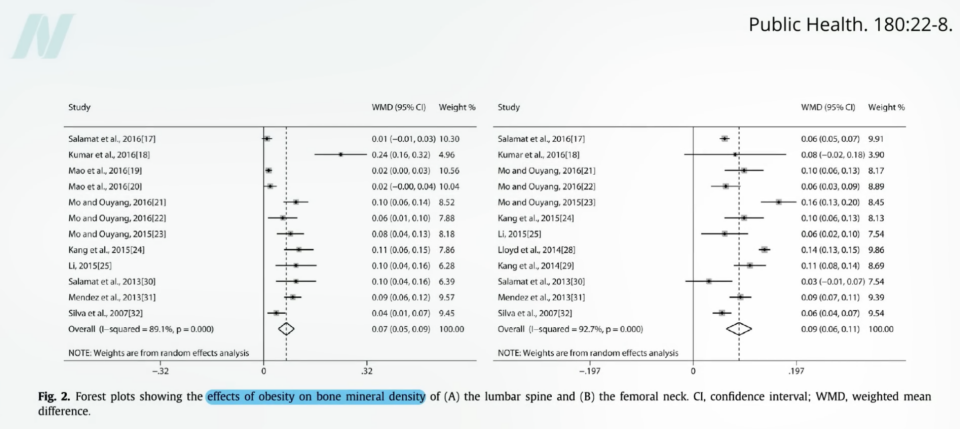
But forget clinical significance—these differences even lost statistical significance after adjusting for body size factors, suggesting that lower bone mass among vegetarians is largely explained by their lower Body Mass Index (BMI) and waist circumference. Thus, it’s not so much the composition of vegetarian and vegan diets as the fact that people who eat them tend to be much slimmer.
Now, a small yet statistically significant difference remained for total lower spine density, a difference of 0.03 g/cm2. This was dismissed as having little clinical relevance, but is that true? If the reproducibility of bone mineral density measurements in daily medical practice is considered, repeated tests performed back to back show some scatter in the measurements, as you can see at 5:44 in my video.
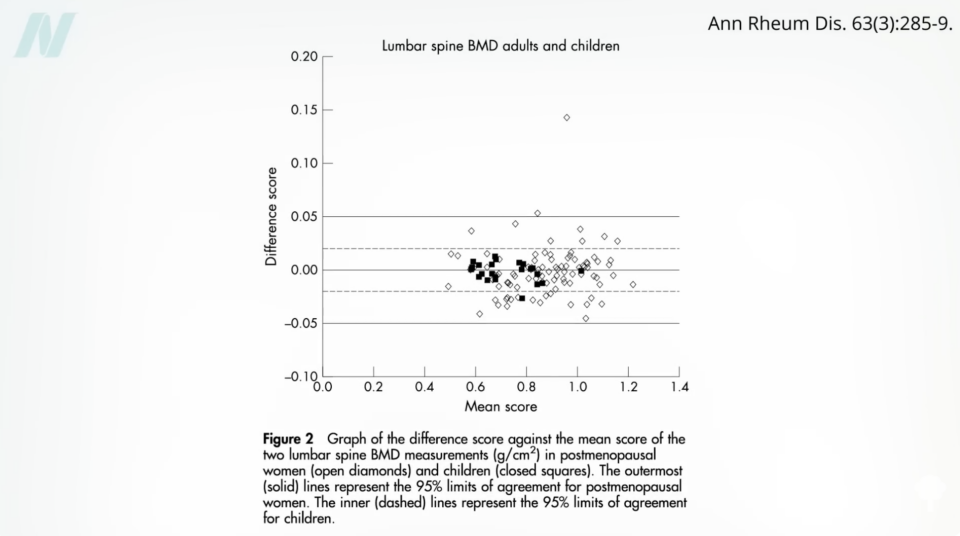
So, a significant difference really has to be more than the inherent variation. Indeed, expressed as the smallest detectable difference, a bone mineral density disparity of at least 0.05 g/cm2 at the spine is needed before it can be considered a significant change, so there does appear to be little clinical relevance. However, even if vegetarians and vegans basically have the same bone density at the same weight, everyone who is skinny is at risk. Low BMI is a risk factor for fractures; so, “all persons in a low body weight category consuming any kind of diet should be monitored for osteoporosis.”
Doctor’s Note
Stay tuned for more on actual bone fracture rates. In this blog, I’m just setting the stage.
In the meantime, check out some of my other videos on bone health:

